
Spintronics: The Tiny Chips Solving The Humanoid Hand
This profitable 35 year old Minnesota chipmaker trading at a $500M market cap is a free call option on the humanoid hand bottleneck.

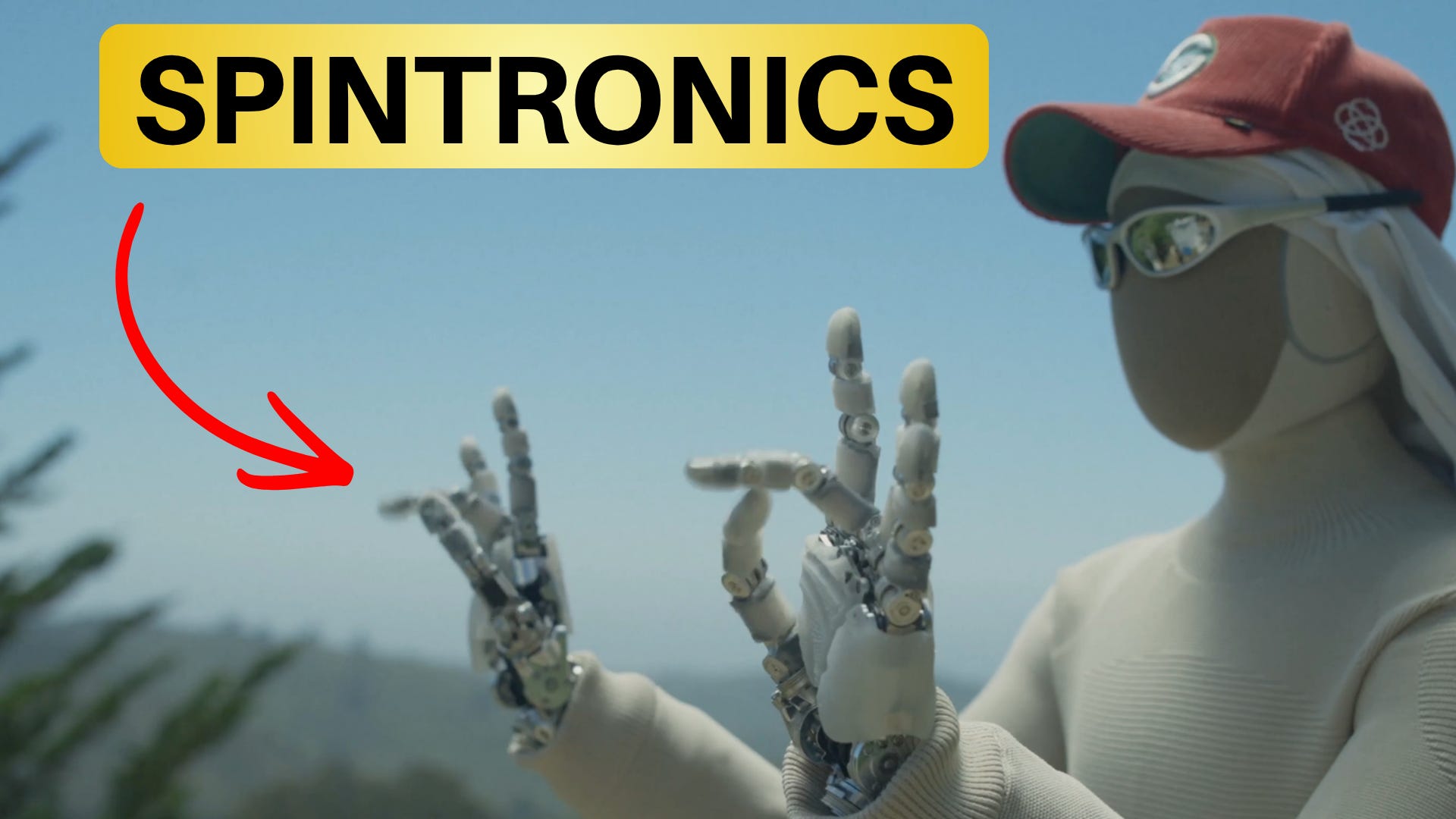
1X just dropped a video of what might be the most advanced humanoid hand anyone has shown publicly, and the timing says a lot.
For seventy years, robotics worked around the hand problem. Factory arms were bolted to the floor and told exactly where every object would be, down to the millimeter, so they never had to feel for anything. The humanoid bet is the reverse: it lives or dies at the fingertips.
That’s why the clip everyone’s reacting to actually matters. Fingers moving with something close to human dexterity is the exact part of the machine the industry spent decades avoiding. Actuators, batteries, and vision raced ahead. The hand stayed the wall.
The hardest thing about a hand isn’t the fingers you can see moving. It’s what the hand can feel. A finger doing delicate work has to know precisely where it is and how hard it’s pressing, in real time, inside one of the most cramped, motion-dense spaces on the whole robot. That demands a sensor small enough to disappear into a fingertip, precise enough to resolve the tiniest movement, and efficient enough to run all day without cooking the hand or draining the pack.
There’s a publicly traded company sitting directly on top of that problem, one that already fabs this exact kind of sensor in-house in the United States, and whose management has confirmed its parts are inside the hands of humanoids today. No one on X is citing it around the robotics thesis.
It runs on a physics effect most investors have never heard of, even though it already changed the world once.
It’s called spintronics.
Before we begin, this Substack is for informational and entertainment purposes only and does not constitute financial advice. Past performance is not indicative of future results. Never invest more than you can afford to lose. Our writers may hold positions in the securities discussed and may buy or sell them at any time without notice.
What Is Spintronics?
Every electronic device you own runs on a basic principle, pushing electrons through a wire and counting the flow. That flow is electric charge, and it’s the electricity in electronics. It’s also why your laptop gets hot and drains its battery, moving all those electrons takes energy.
Spintronics uses a second, hidden property of the electron that normal electronics ignores completely (its spin).
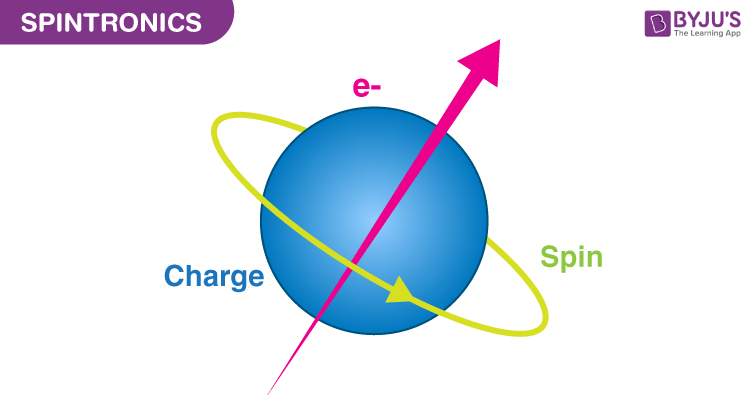
Every electron behaves like an impossibly tiny magnet, with a north and a south pole. Think of it as a microscopic compass needle that can point one way or the other.
Regular electronics doesn’t care which way it points, but spintronics counts on it. And here’s part of the reason spintronics is a game changer:
a compass needle holds its direction without any power, so reading spin can be done with almost none.
That simple physics principle unlocks multiple benefits. Spintronics can sense magnetic information:
with extreme precision
using barely any power
in a package small enough to vanish on your fingertip.
Its first job was inside the hard drive. By reading the faint magnetic “spin” of data on a spinning disk, spintronic sensors could detect smaller and smaller signals, cramming exponentially more storage into the same space.
This was the breakthrough that made cheap digital storage possible.
But a device that senses tiny magnetic fields with pinpoint accuracy isn’t just useful for reading a disk. It can sense the physical world. As NVE’s management recently put it:
“Magnetic sensors can be used for many purposes, including detecting the position or speed of robotics and mechanisms, or for communicating with implantable medical devices.”
The same physics that once read bits off a hard drive can now tell a robot where its fingers are, or talk to a pacemaker inside someone’s chest. And management is seeing spintronics utilization in new technologies happen in real time.
Following that acknowledgement, and forecasts of possible spintronics supercycle, they recently doubled their operational capacity, a project completed just last quarter.
Spintronics has seen a bump in procurement with use in modern technologies, but some research firms are forecasting an upcoming explosion in growth for the wider spintronics market.
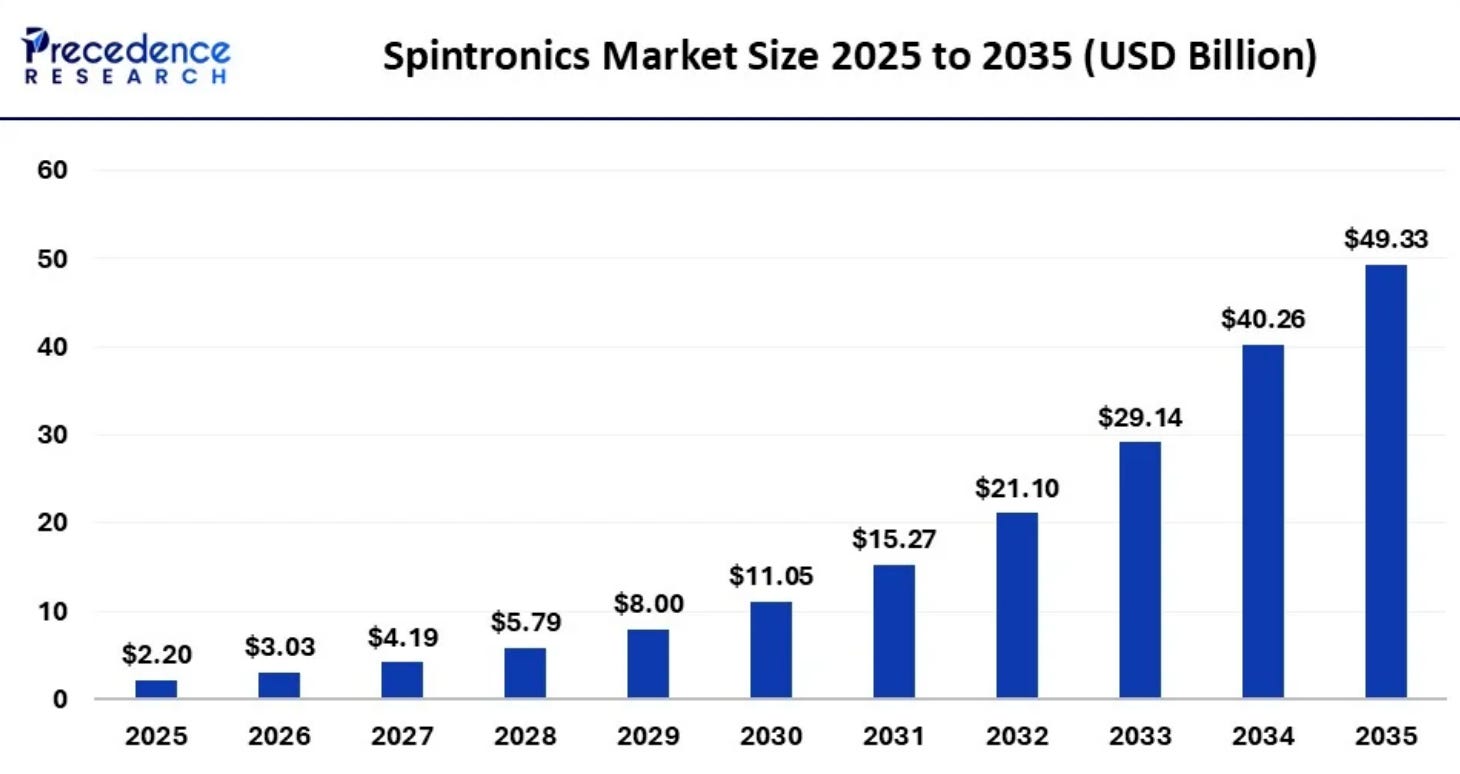
Precedence research forecasts the overall spintronics market growing at a 36.48% CAGR from $2.2B in 2026, to $49.33B in 2035.
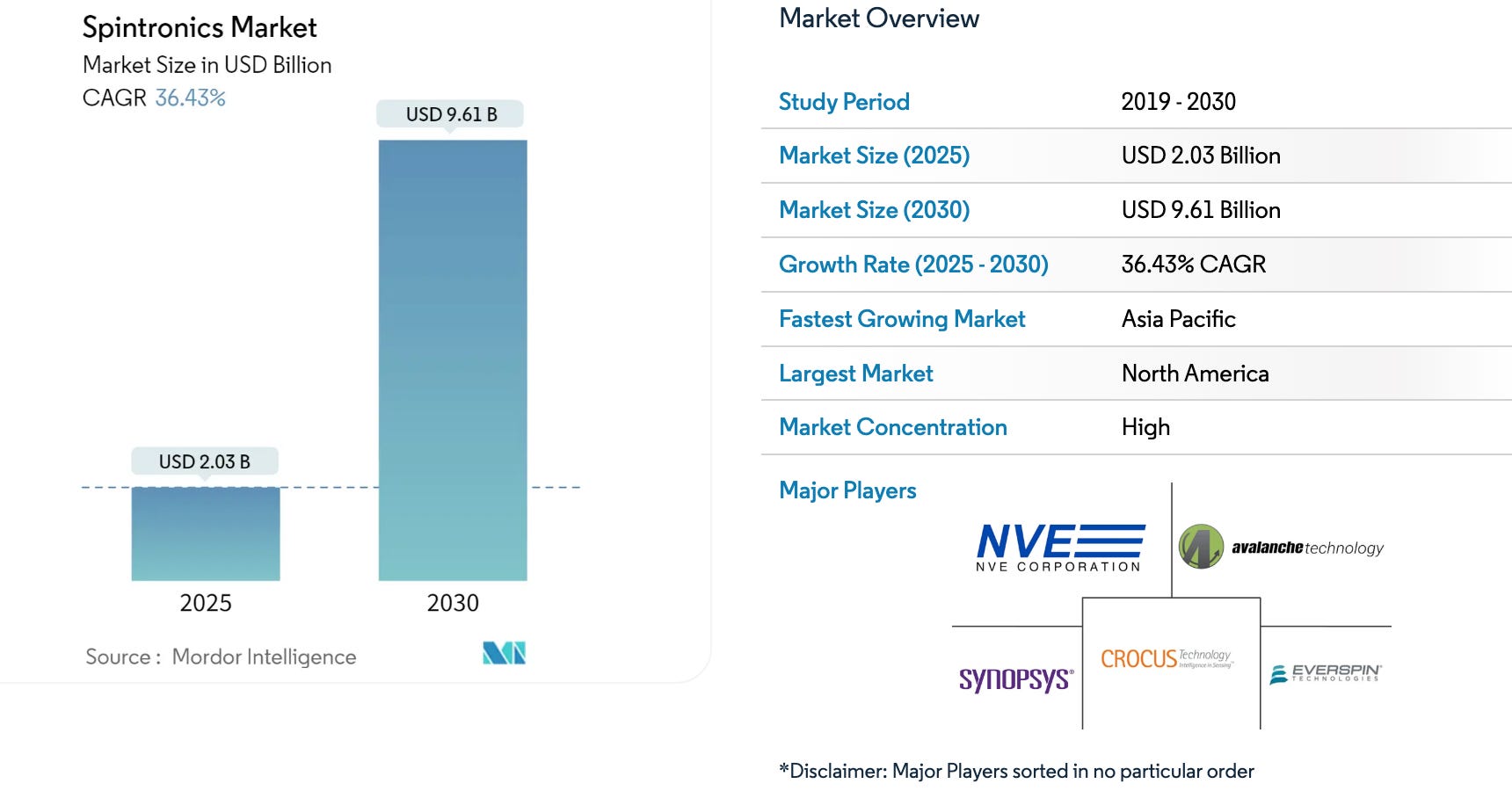
Mordor Intelligence forecasts a similar CAGR of 36.43% from 2025 to 2030, estimating that the market grows from roughly $2.03B in 2025 to $9.61B in 2030.
Mordor Intelligence even lists the company as a “Major Player”.
NVE: The Quiet Humanoid Robotics Play The Market is Ignoring
They were founded in 1989 by Dr. James Daughton, a former Honeywell executive and one of the early pioneers of the field, a man who helped invent spintronics.
The company is NVE Corp (NASDAQ: NVEC)
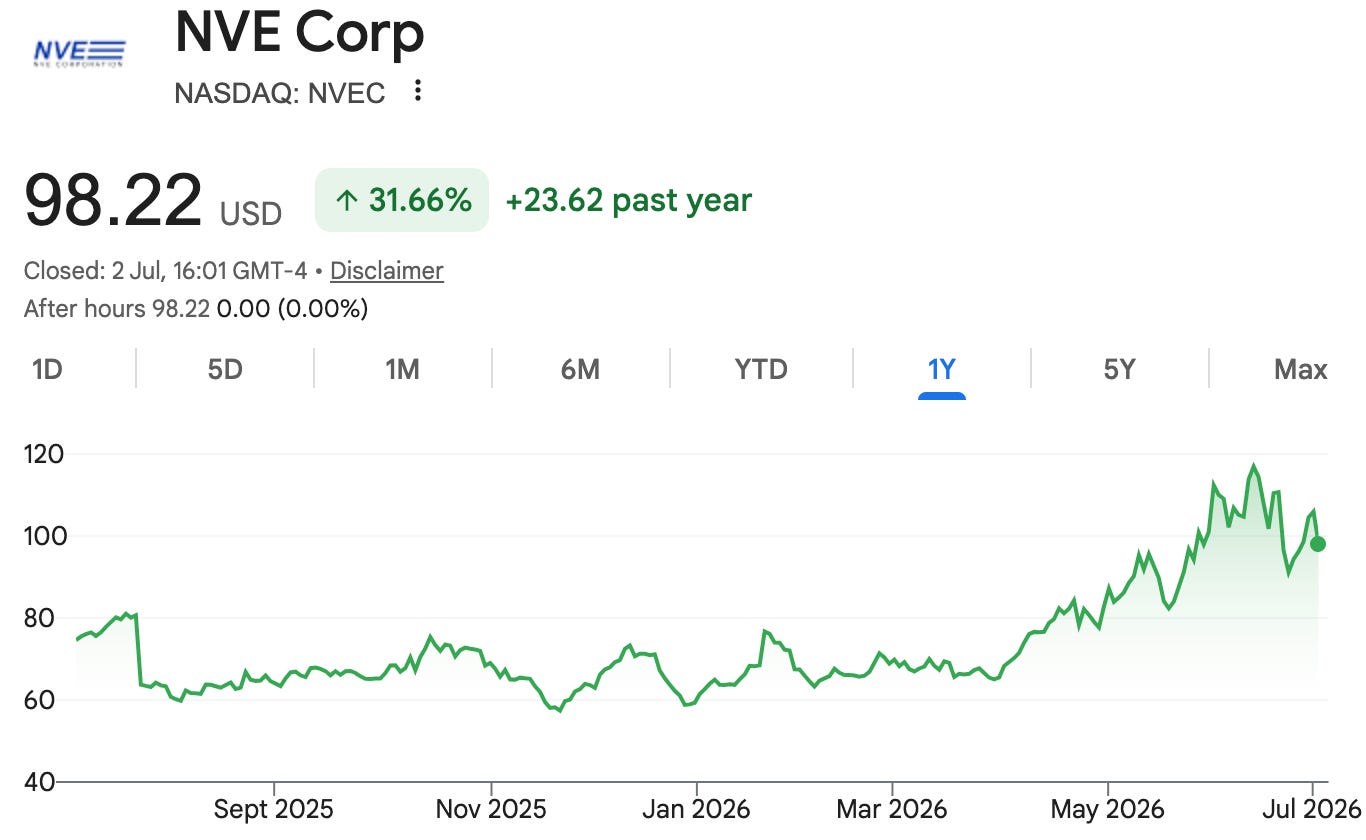
~ $475M market cap
~ $5M quarterly net income
~ 60% net margins
~ $1M debt
~ $20M cash
~ 93% institutional ownership
For years the company survived on defense research grants while learning to manufacture spintronic materials at production quality, in house, in the United States.
NVE deposits its own spintronic films and packages its own sensors on its own line. In a sensor world increasingly dependent on Asian foundries, that in house U.S. fabrication is a moat as companies shift purchase priority to U.S. companies.
NVE describes its two product families as:
sensors that are the eyes of an electronic system
couplers and isolators that are the nerves of an electronic system
This is what makes NVE spintronics ideal for a machine that needs eyes and nerves at the smallest possible scale, such as for humanoids.
Recently, management has confirmed that NVE has a customer that’s already put NVE’s product inside the hands of humanoids, more on that later.
The medical anchor:
NVE has been a component supplier to Abbott, the medical device giant, through Abbott’s Pacesetter subsidiary under a formal supplier partnering agreement.
“NVE has decades of experience with medical instruments, surgical robots, and medical devices, including life-sustaining applications.”
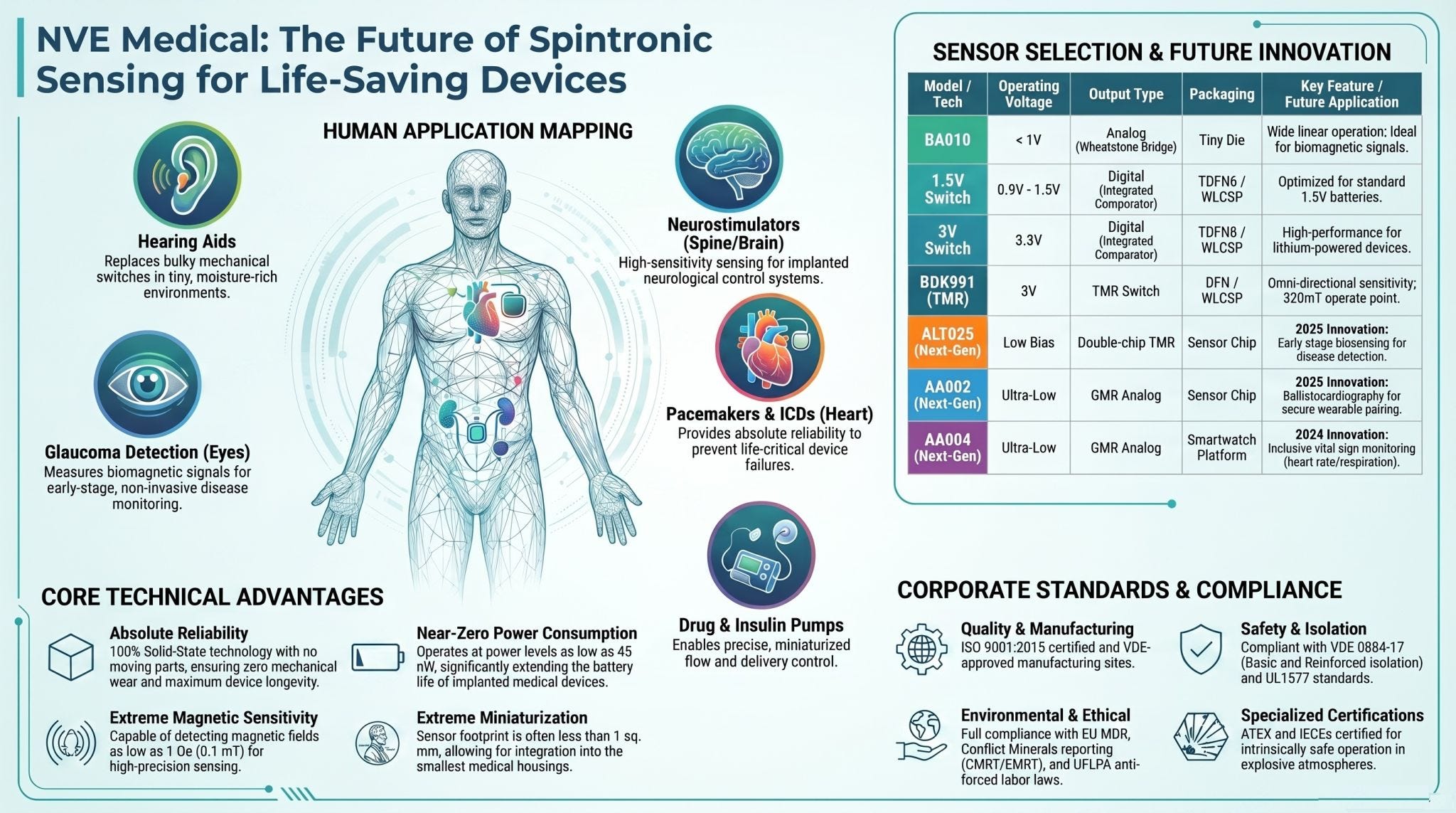
What management is referring to is the supplier deal with Abbott. NVE is likely integrated into Abbott’s pacemaker, a device that keeps the heart beating if it can’t reliably beat on its own.
NVE likely having successfully been integrated into pacemakers for over two decades is almost the equivalent of having battle tested technology in the defense sector.
Abbott likely accounts for 37% of NVE’s revenue, we view this as establishing somewhat of a floor. A recurring, high margin, deeply embedded revenue from a customer that can’t easily switch.
Switching a component inside a life sustaining implant means requalifying the entire device with regulators.
And why do that if it’s been working perfectly fine, keeping people alive for over 20 years?
This recurring business has helped provide NVE the funds to recently double their operational capacity, which was just recently completed.
That has suppressed cash flow for the past two years. Now with new capacity and more cash flow, a setup is emerging that resembles a coiled spring.
The rest of our NVEC 0.00%↑ report is available to paid subscribers only.
Join hundreds of asymmetry seekers getting access to:
Multiple deep dive articles weekly
VIP discord server with private chat and daily trade alerts/analysis from 4 analysts
Around the clock support/guidance from Michael, Kawz, and AB analyst team
Get Michael and Kawz’s $70M Autopilot fund copy trade updates ($400/year separate value included)