
The Sovereign Quantum Trade
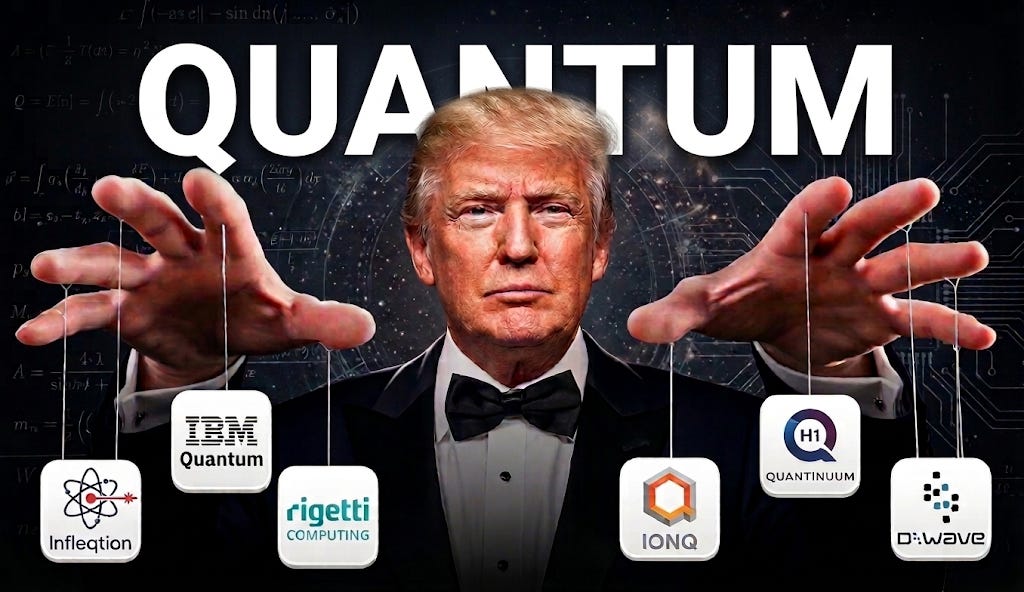
The Trump Administration is investing $2B into Quantum. So we ranked every stock and identified our #1 quantum stock pick for 2026.

At Nvidia GTC, our focus was getting deep on networking. Of course that paid off. Our top two photonics picks AAOI 0.00%↑ and Soitec have roughly tripled since their lows that week.
But a few booths pulled us off the race track for a pit stop.
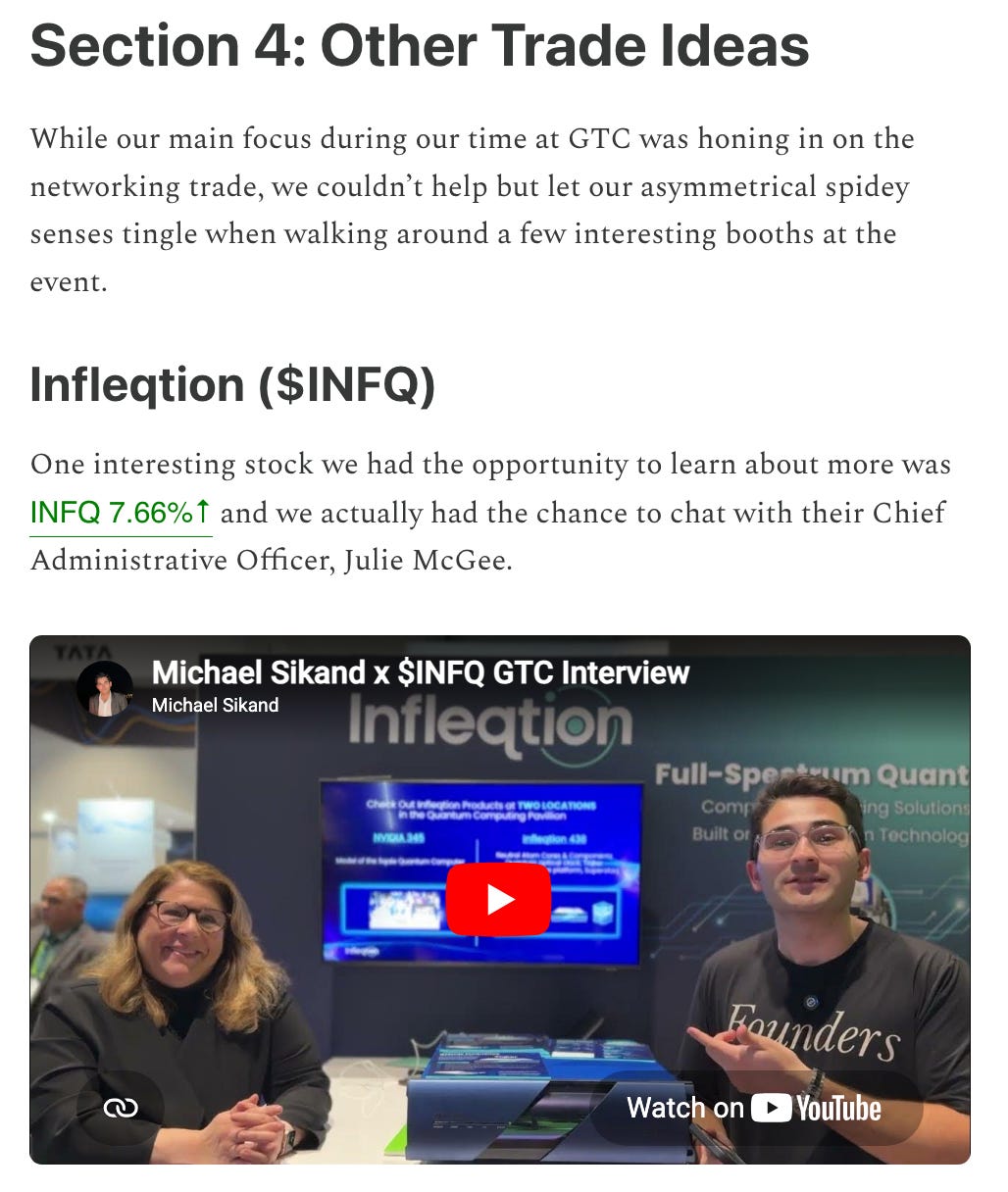
One of them was Infleqtion INFQ 0.00%↑, where we had the chance to interview with their Chief Administrative Officer, Julie McGee.
The pitch was hard to ignore, a newly SPAC’d neutral atom quantum company, trading roughly 40% below its IPO price at a sub $2B market cap, already shipping real product to NASA, the DoD, and the UK government while most of the sector burned cash with nothing to show for it. We flagged it back at $8 in our Nvidia GTC deep dive as one of our favorite picks from the event. It hit $20 on June 2.
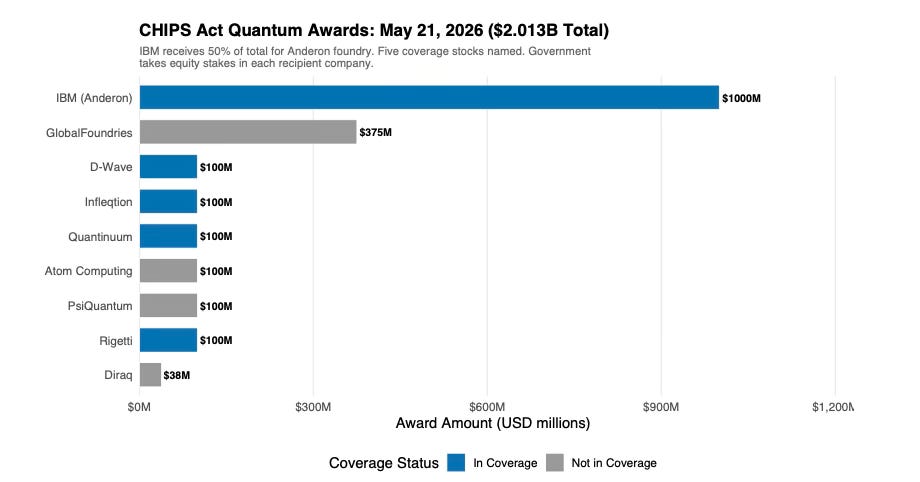
Then May 21 happened, and one company that piqued our interest as a speculative idea is now a key player in a sector wide, government backed re-rating.
The Federal Government has committed $2.013 billion of CHIPS Act funding in exchange for minority, non controlling equity in nine quantum companies.
IBM took the largest piece at $1 billion to launch a foundry called Anderon, GlobalFoundries drew $375 million, and a tier of speculative small cap computing names including D-Wave, Rigetti, and Infleqtion landed roughly $100 million apiece. Outside of IBM and GlobalFoundries, most of these are pre-revenue or barely-revenue generating companies. These are the kind of names Washington might have historically funded with grants, not equity.
All these stocks have re-rated violently since the announcement.
INFQ +86.9%
QBTS +64.4%
RGTI +61.7%
IONQ +47.4%
IBM +30.1%
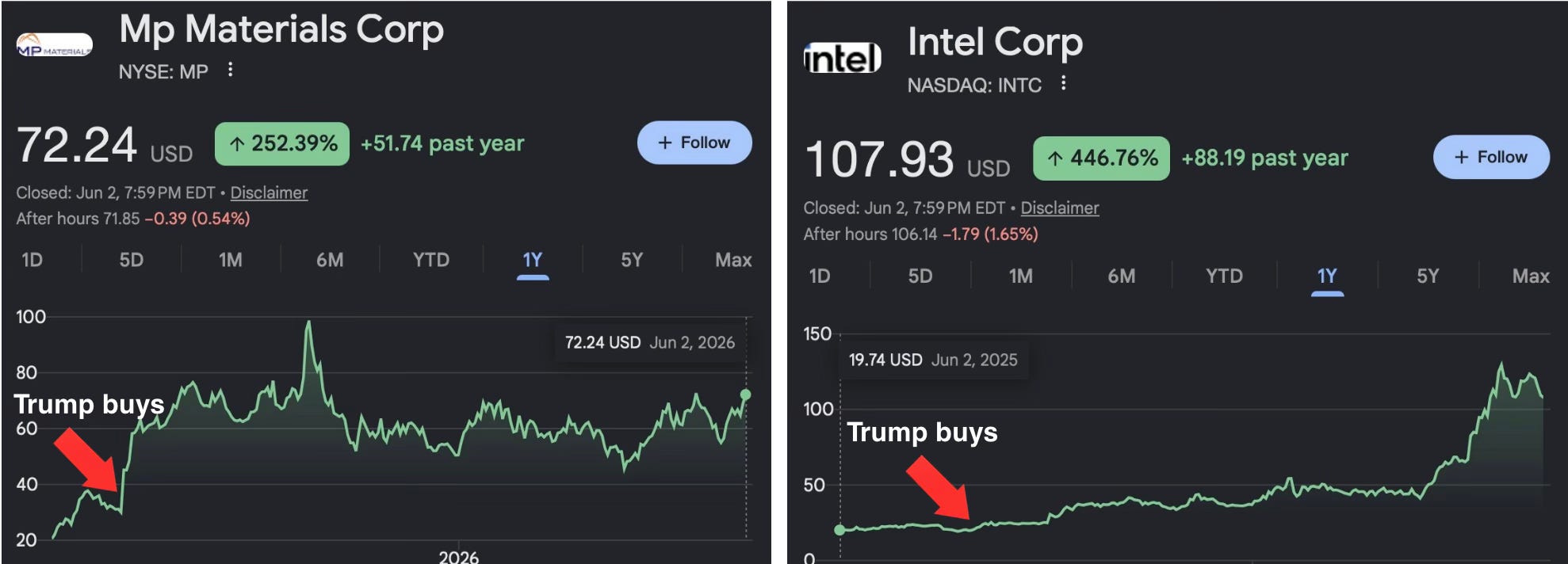
Before you scoff at the charts. This government stake re-rate event isn’t a brand new mechanic.
This is the same deal structure the Government already applied to MP Materials MP 0.00%↑ and INTC 0.00%↑, where a sovereign stake was just a catalyst in driving long term outperformance (in INTC’s case 250%+). With an industry as early as Quantum, it’s likely these government stakes carry even more strategic value than they did in rare earths or chips.
We are not telling you quantum is tomorrow, or that fault tolerance arrives next year, because it wont’. Our capital and interest still lives where the real, near term earnings and revenue growth lie in sectors like AI infrastructure.
What we believe is that these federal stakes are a genuine re-rating event, the same way they were for names like MP 0.00%↑ or INTC 0.00%↑.
We’re not writing this piece so you can rush into a quantum trade in the hopes of getting rich this week. We’re here to lay out the chess board and teach you the rules of the game.
In today’s report, we’ll give you a succint, digestible breakdown of what Quantum is.
Then we’ll be ranking every pure play stock in the sector, before revealing our #1 Quantum stock pick.
This is not financial advice. All content provided on this Substack is for educational purposes only. Investing involves risk and you must do your own research.
What is Quantum Computing?
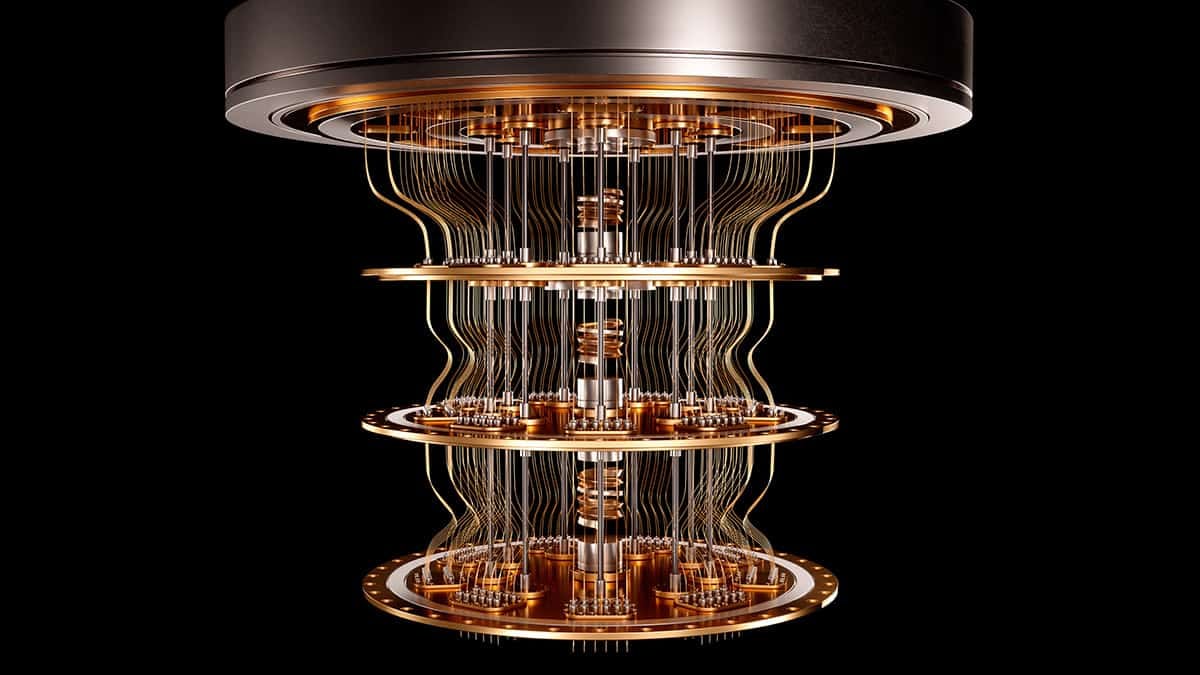
Quantum computing sounds like sci-fi, but the investment case rests on a few ideas simpler than they sound. Classical computers fail at certain problems not because they are slow but because the difficulty grows exponentially with input size. To model how electrons interact in a molecule with N particles, a classical computer has to track 2^N states. At 100 particles that exceeds the number of atoms in the observable universe. The same wall blocks factoring large numbers, designing battery chemistries, simulating drugs, and global logistics. Quantum computers attack these problems through different physics.
The qubit. A classical bit is 0 or 1. A qubit can be 0, 1, or a weighted blend at the same time, a property called superposition. Two qubits hold four combinations at once, ten hold 1,024, and 300 qubits hold more states than there are atoms in the known universe. Each qubit doubles the space, so quantum scales exponentially against classical’s linear path.
Entanglement. Quantum’s second property links two qubits so they behave as one connected system regardless of distance. Measure one, and you instantly know the other. Einstein called it “spooky action at a distance,” and it lets qubits work together rather than as independent switches.
Interference. Superposition gives access to many possible answers, but a measurement returns only one. Quantum states behave like waves that can cancel or reinforce. A good algorithm makes wrong answers cancel and the right one amplify, so the correct result is what survives at measurement. The machine is not trying every answer in parallel, it is orchestrating an interference pattern. This is how Shor’s algorithm factors large numbers far faster than any classical method (which is why intelligence agencies care), how Grover’s algorithm searches unstructured databases quadratically faster, and how quantum chemistry algorithms simulate molecules classical machines cannot.
A Mouse in a Maze
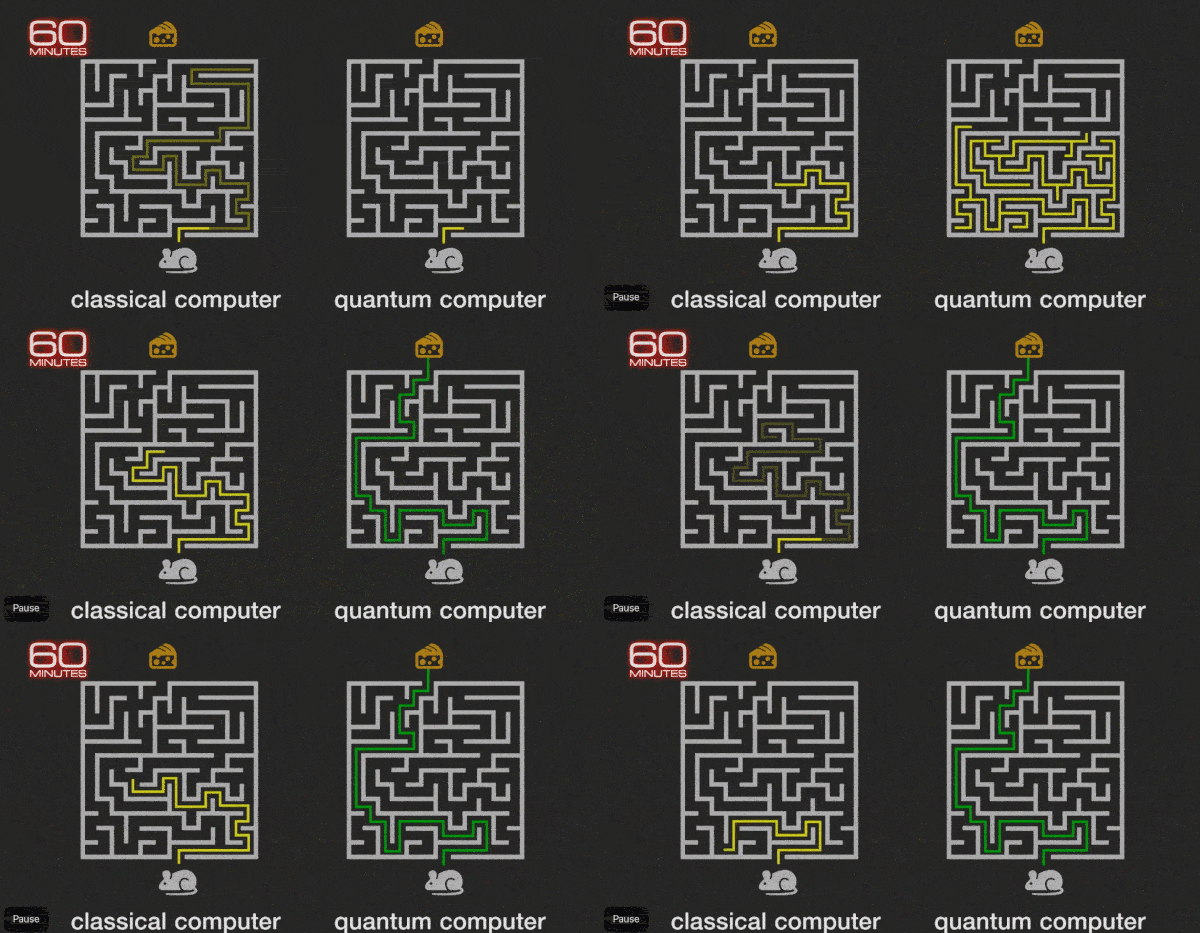
Picture a mouse solving a maze. A classical computer sends the mouse down one path, hits a dead end, backs up, and tries the next. A GPU does this very fast with thousands of mice at once, but each still checks one route at a time, and the paths multiply exponentially as the maze grows. A quantum computer puts a single mouse down every path simultaneously, lets superposition explore all routes at once, and uses interference to erase the dead ends so the correct path is what remains at measurement.
Five Ways to Build a Qubit
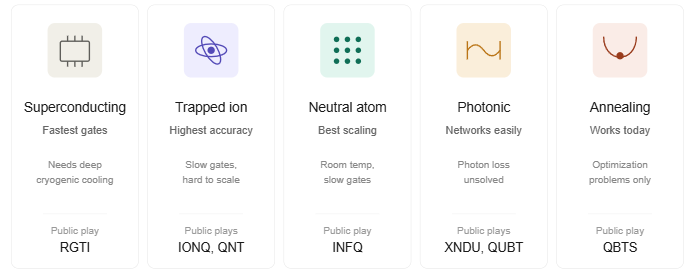
How you physically build a qubit changes everything. Each approach has different tradeoffs in speed, accuracy, scalability, and cost.
Superconducting chills tiny niobium or aluminum circuits to near absolute zero so they behave like artificial atoms, controlled by microwave pulses. Gate speeds are the fastest in the field, roughly 1,000 times the alternatives, and manufacturing draws on the chip industry. The cost is brutal cryogenics and a punishing ratio of physical to logical qubits. Public play: Rigetti. IBM, Google, and IQM also here.
Trapped ion holds individual charged atoms in electromagnetic traps and manipulates them with lasers or precision electronics. It delivers the highest accuracy and longest coherence times in the industry, but gates are slow and packing many ions into one trap requires complex shuttling. Public plays: IonQ and Quantinuum.
Neutral atom holds uncharged atoms in arrays of laser optical tweezers and entangles them through excited Rydberg states. The wins are room temperature operation, the best demonstrated scaling, flexible connectivity, and the most efficient error correction shown to date. The drawbacks are slow gates and atom loss. This is the modality Google and Microsoft both moved into in 2026. Public play: Infleqtion (and Pasqal once it lists).
Photonic uses particles of light as qubits, routed through silicon chips. It runs mostly at room temperature, networks naturally over fiber, and leans on existing telecom manufacturing. The unsolved problem is photon loss at every junction. Public plays: Xanadu and Quantum Computing Inc, with PsiQuantum private.
Annealing encodes an optimization problem into coupled qubits and lets the system settle into its lowest energy state, which is the answer. It cannot break encryption but it solves real optimization problems in production today. Public play: D-Wave.
Quantum Is Now?
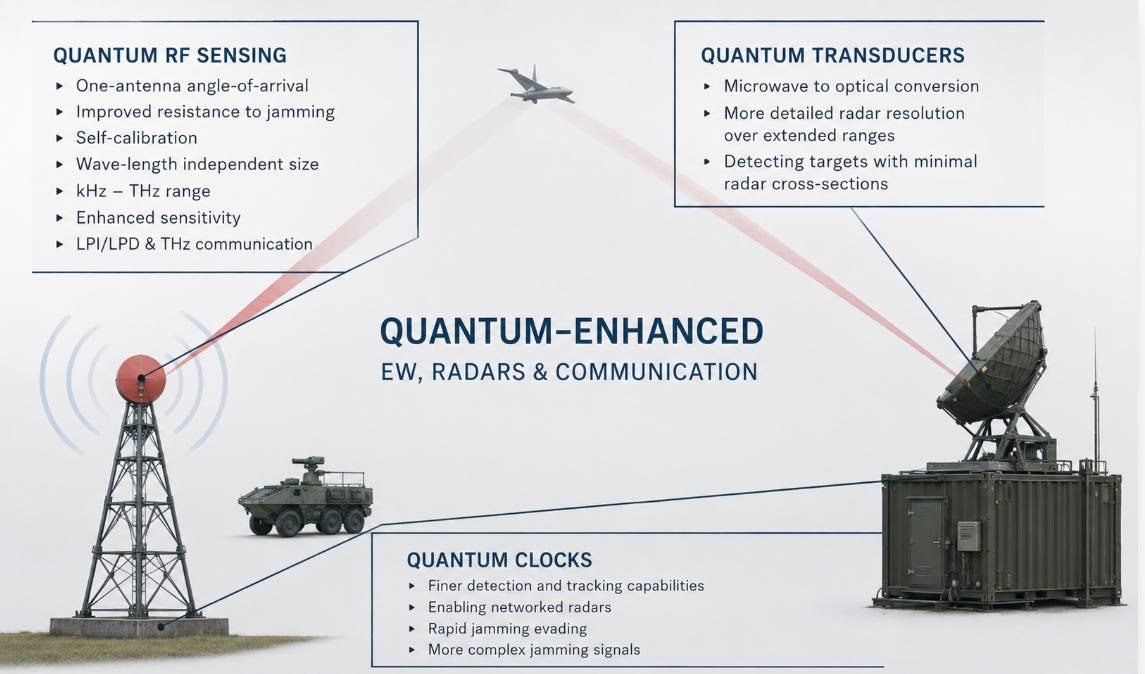
While fault tolerance is still years out, several quantum technologies deliver measurable advantages today.
Quantum sensing and timing is the clearest case.
Atomic clocks, gravimeters, magnetometers, and inertial navigation units built on quantum effects already outperform their classical versions. Infleqtion’s Tiqker atomic clock is heading to the ISS through Voyager and into resilient timing systems through Safran, generating real defense and space revenue today.
Quantum communication is similarly live, with China running a 12,000 kilometer secured network and IonQ building a commercial networking business around space to ground links. Quantum annealing is in production for D-Wave customers like Ford Otosan and BASF. And Quantinuum’s certified quantum randomness, published in Nature in March 2026, was the first gate model machine producing something useful that a classical computer cannot.
The Stocks & Ranking Criteria
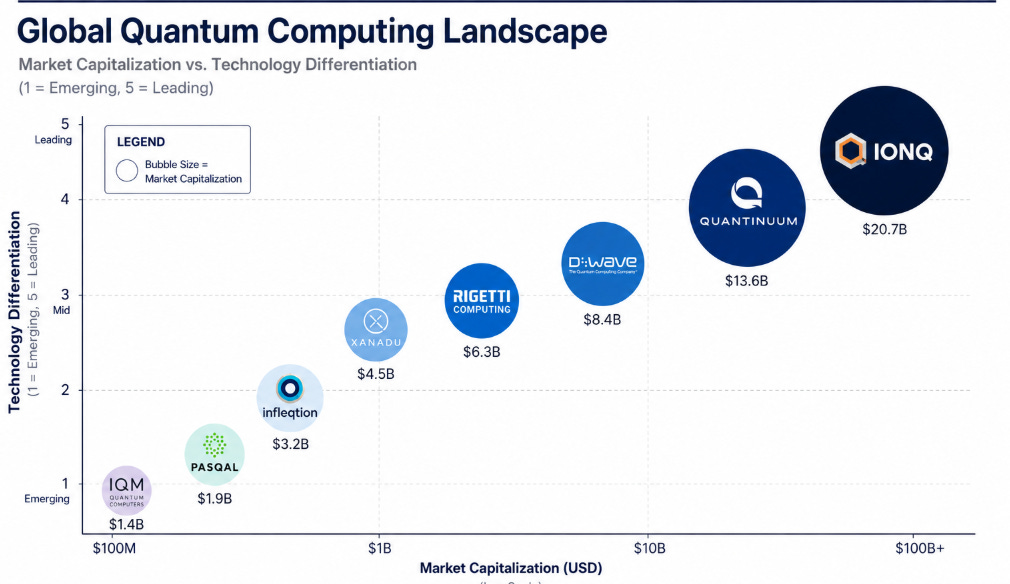
Every Quantum stock is wildly different, from their technology to their revenue profile, to their customers, and use cases.
To navigate this diveristy, we built an “Asymmetrical Bets” Quantum scorecard composed of two separate scores for each stock based on two vectors.
The technical score asks how close the company is to building a quantum computer that does useful work. The biggest inputs are logical qubit count, gate accuracy when two qubits interact (above 99.9% is leading edge), and how efficiently raw qubits become useful ones. Roadmaps get discounted since every company has ambitious slides, and we credit quantum advantage already in production, including sensing applications working today.
The financial score asks whether this is a real business yet. We weigh organic revenue, growth, backlog, and cash on hand. The Trump $2 billion CHIPS list gets extra credit as a sovereign backstop, and we mark down for heavy dilution and share overhangs. A 10 means best in class. A 5 means promise without enough proof.
The rest of our Sovereign Quantum Report is available to paying subscribers only.
By joining hundreds of passionate paid members, you’ll get:
Our entire research archive + 1-2 weekly deep dives on the most asymmetrical stocks and sectors
Access to our VIP discord server community
Engaged private chat room with us and other paid members
Offering daily buy/sell alerts from 4 analysts: Michael, Kawz, Bull Of Britain (20K+ on X) , and CK Capital (50K+ on X)
Complementary access to trade alerts on our $50M+ AUM actively-managed Autopilot strategies tracking sectors like Photonics, Memory, and Space