
This $2B Photonics Monopoly Down 75% Is Key To AI's Next Paradigm Shift
At GTC, Jensen Huang indicated that co-packaged optics is the key to building 1M GPU AI factories. We think this down bad French semi stock explodes from it.


We recently spent 36 hours at the world’s biggest AI event to better understand the next seismic shift in artificial intelligence infrastructure.
After asking Jensen a question and even interviewing Nvidia’s SVP of Networking, we think it’s less about chips and more about connecting those chips together to maximize power efficiency and speed.
This is where silicon photonics comes in. And the entire silicon photonics revolution: NVIDIA’s CPO switches, Broadcom’s data center ASICs, the 800G and 1.6T transceivers running through AWS, Google, Meta, and Microsoft, runs on a single engineered material.
And one company supplies nearly 100% of it. The market is either not patient enough to wait for the money to show up or simply can’t see past its current depressed state.
Soitec’s multi-bagger story isn’t going to happen loudly. It won’t happen through vaporware press releases, an X driven meme stock rally, or earnings call bravado.
It will happen quietly, in a lab in the French Alps, where over three decades of ion implantation has led to a monopoly in one of the fastest growing segments of AI infrastructure.
Right now, most would call us crazy for covering Soitec.
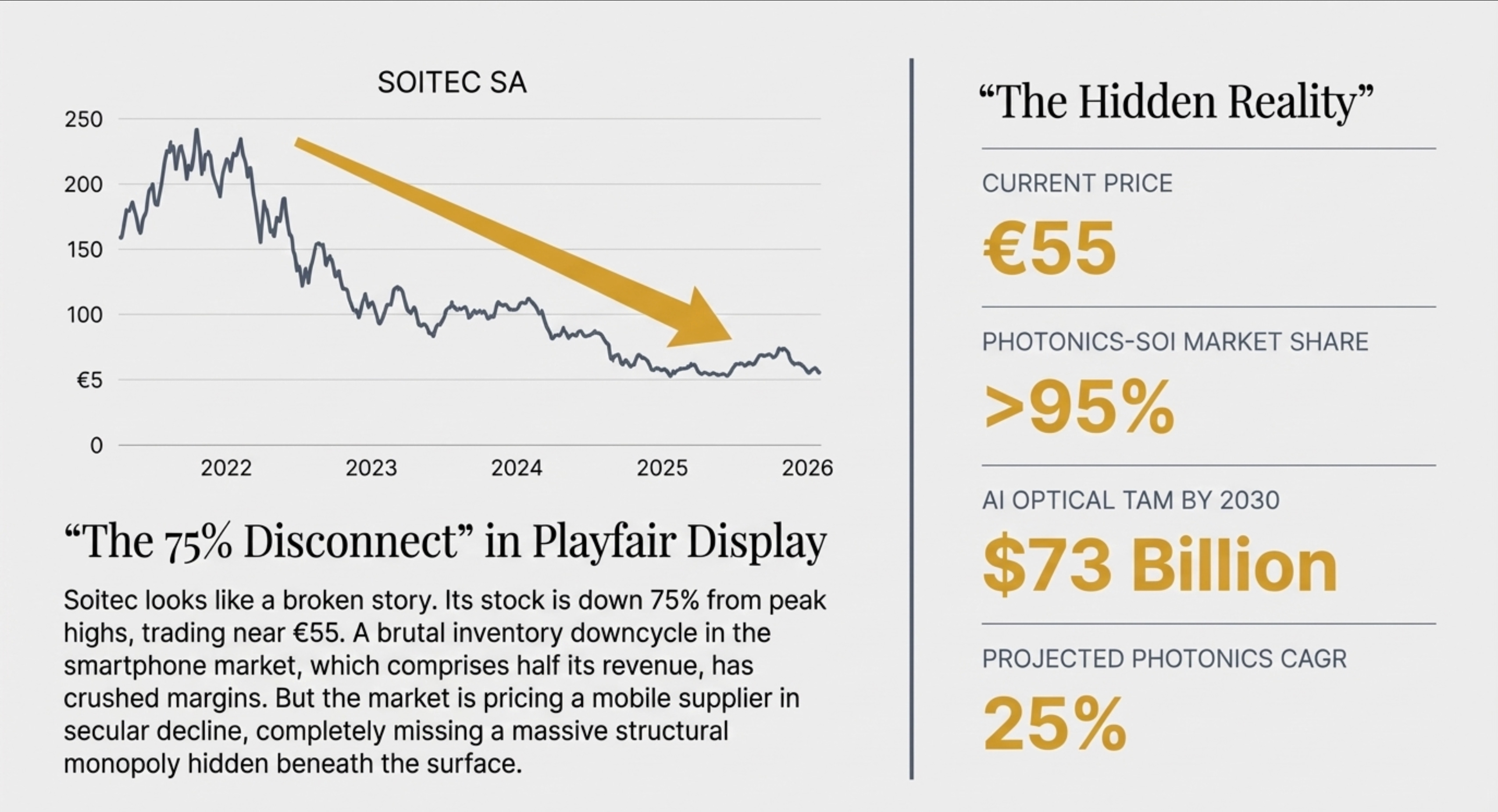
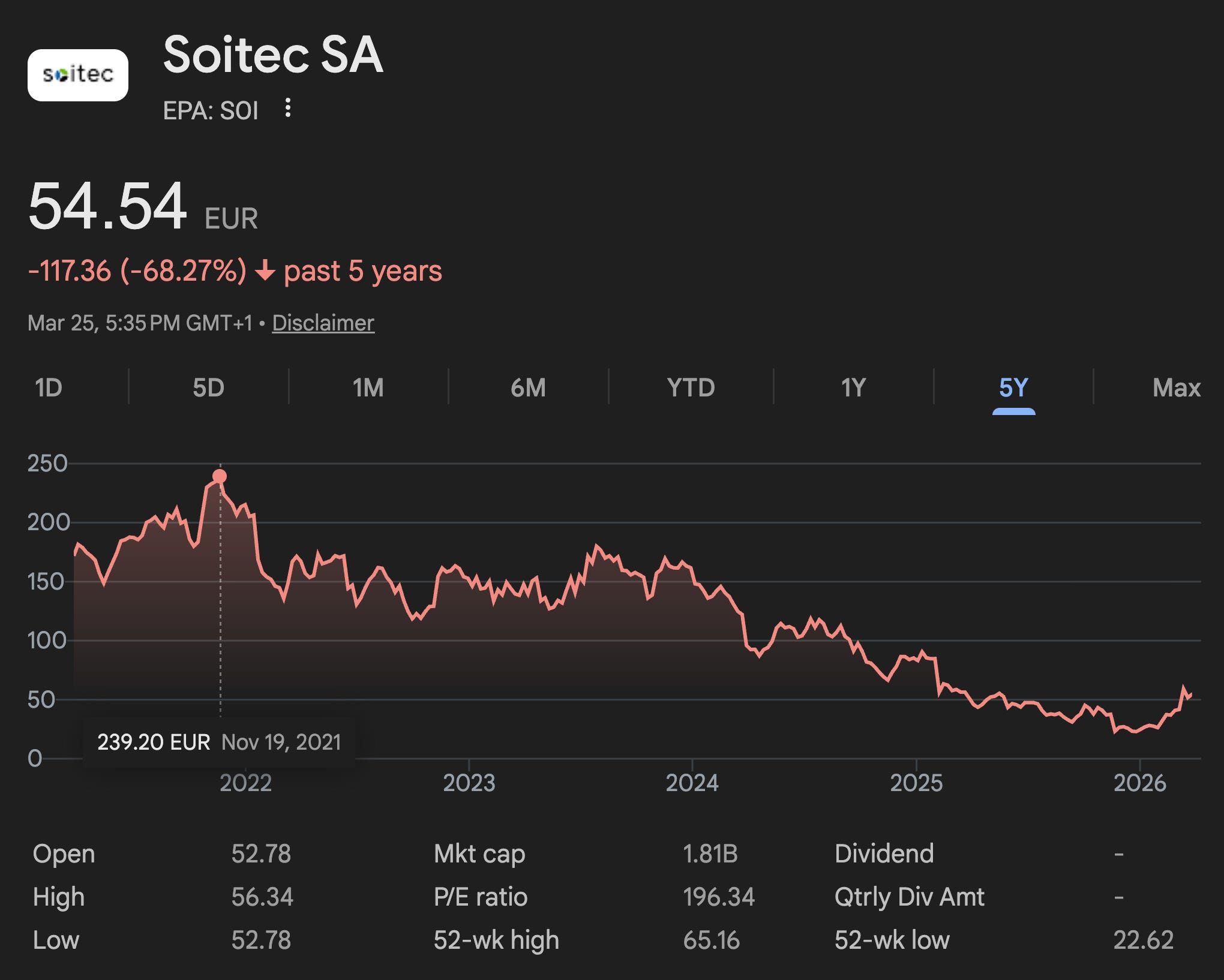
The stock is down 75% from its all time highs. Analyst consensus is well below its current price. The CEO is retiring this week. The mobile business, which makes up half of revenue, has been getting crushed in an inventory down cycle.
Despite this, Soitec’s “Photonics-SOI is used in every new AI data center,” according to Bank of America Global Research.
That same report cites that optical interconnect market is going from $14 billion to $73 billion by 2030.
That’s a 39% compound annual growth rate. Silicon photonics goes from 38% penetration of AI optical units today to 84% by 2030.
Every single one of those chips, every transceiver, every co-packaged optics module, every NVIDIA Spectrum-X and Quantum-X switch and Broadcom Davisson and Marvell Celestial AI chiplet, is fabricated on a substrate that exactly one company on earth produces at volume and is qualified for at all the foundries.
Here’s why Soitec is our god-tier long on photonics.
Disclaimer: This newsletter is for informational and entertainment purposes only and does not constitute investment advice. All investments involve risk, including the possible loss of principal. Past performance is not indicative of future results. Always do your own research and consult a licensed financial advisor before making investment decisions. The author(s) may hold positions in securities mentioned in this article. Soitec (EPA: SOI) is a smallcap European listed equity and may not be accessible on all retail brokerage platforms. Liquidity may be limited. This is a high risk, high reward trade idea intended for experienced investors who understand the risks involved.
Part 1: The Wafer Wonderland Nestled In The French Alps
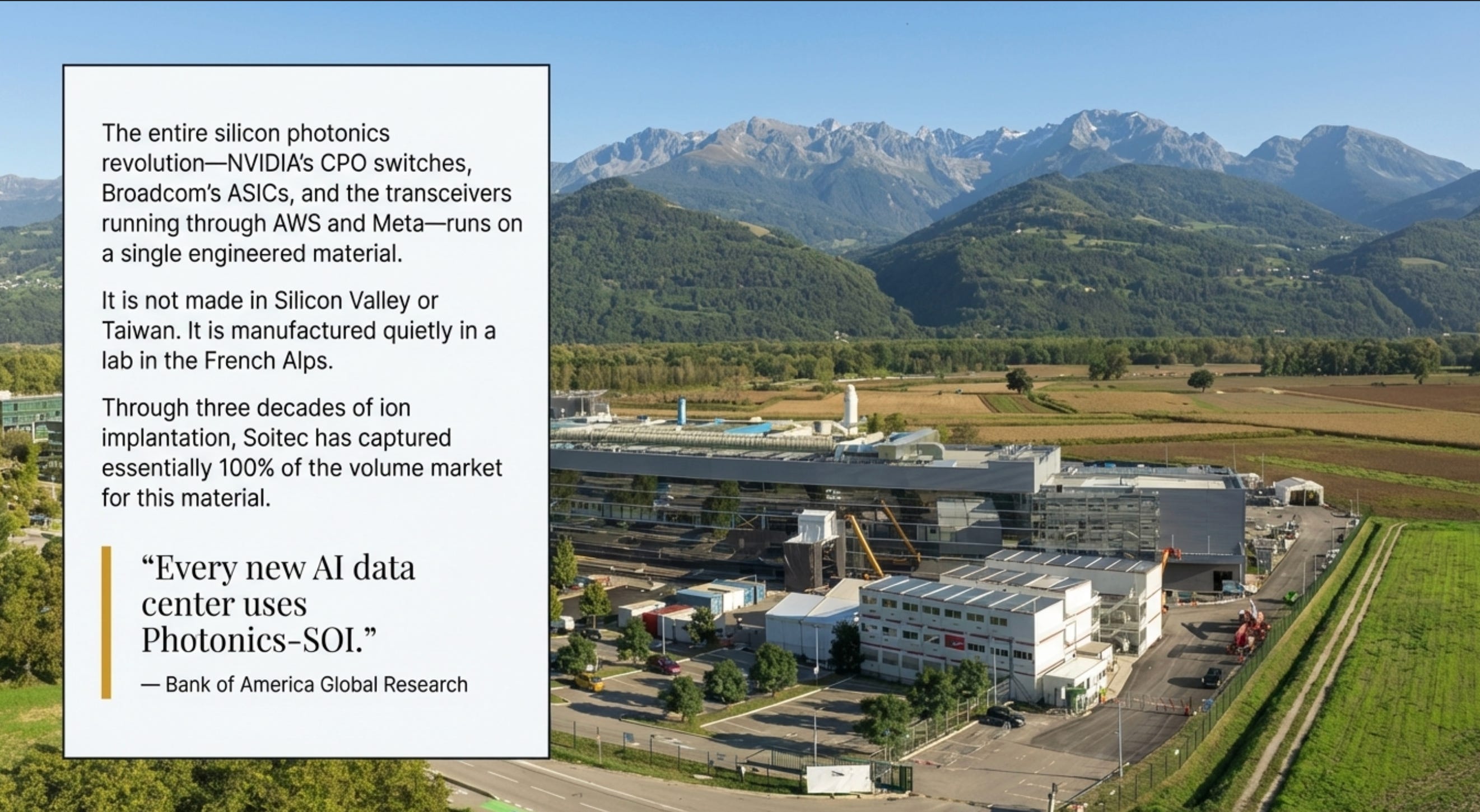
Soitec S.A. (Euronext Paris: SOI, US OTC: SLOIF / SLOIY) is a French semiconductor materials company founded in 1992 and headquartered in Bernin, a small commune in the French Alps outside Grenoble.
As of this moment, Soitec sits roughly at a €2 billion market cap. Revenue for FY2025 was €891 million, down from the 2023 high of just over €1 billion. This decline is the result of weakness in the smartphone market as a result of higher inventories at customers due to excessive stocking during the pandemic. The automotive market is also showing signs of weakness currently. This is why the stock is down ~75% from prior highs.
The weakness in the automotive and smartphone markets has resulted in lower margins. After all, the manufacturing sites cost a lot of money whether you use them or not. Gross margins have decreased from 37% in 2023 to around 32% in 2025 and operating margin sits just below 15% in 2025 from almost 25% in 2023.
What Does Soitec Actually Do?
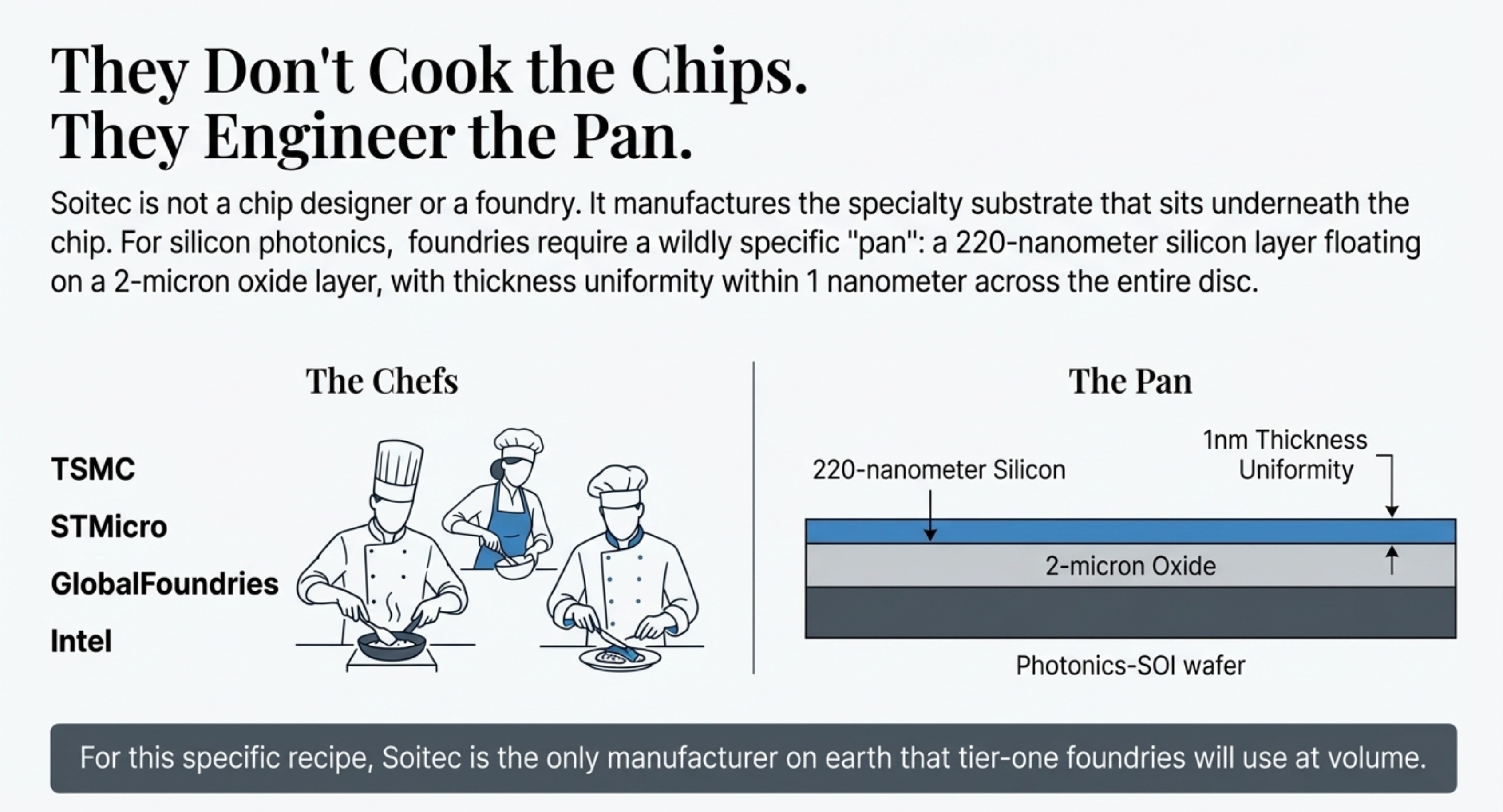
Soitec is not a chip designer. It’s not a foundry. It makes the engineered semiconductor substrate, the specialty wafer that sits underneath the chip. Think of it this way. TSMC, Tower Semiconductor, GlobalFoundries, STMicro, these are the chefs. Soitec makes the pan. And for one specific category of pan, the kind required to bake silicon photonics chips, they are the only manufacturer on earth that foundries will actually use at volume.
The product is called Photonics-SOI. Silicon-on-Insulator wafers engineered to a roughly 220 nanometer silicon layer sitting on a 2 micron buried oxide layer. The silicon thickness uniformity must be within 1 nanometer across the entire wafer. The defect density must be below 0.1 per square centimeter. These are not specs you replicate by accident. They require a proprietary process called Smart Cut, a hydrogen ion implantation and thermal cleave technology that Soitec has spent 30 years refining into approximately 4,300 active patents worldwide.
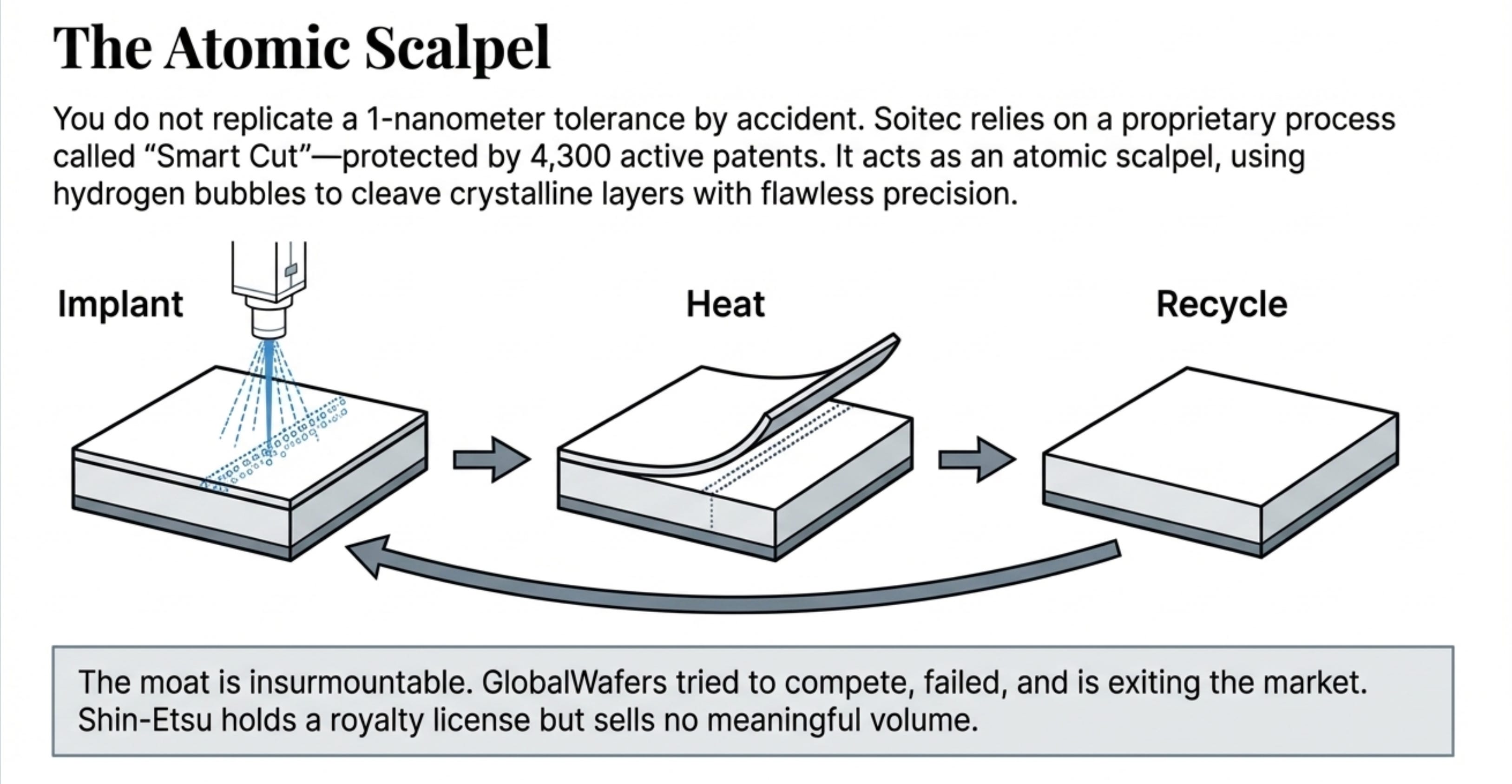
Think of Smart Cut as a scalpel on an atomic scale. By implanting hydrogen ions at precise depths, microscopic bubbles are created. Think of these bubbles as a perforation line. If they are heated up, they pop across the entire wafer. This is how Soitec is able to decide exactly where a cut is made. It allows them to position a crystalline layer of perfect quality on all types of materials, including silicon. And the excess wafer that is cut off? It becomes the starting point of a new Smart Cut production cycle. Europeans sure do love recycling.
Is There Competition?
GlobalWafers tried to compete, but their Smart Cut license was terminated in October 2023, with a settlement confirmed in July 2025 granting an extension until 2027 before they exit the market entirely. Shin-Etsu Chemical holds a royalty license but sells no meaningful volume in photonics-grade SOI. Meanwhile, NSIG/Simgui in China produces 200mm wafers exclusively for the domestic market, and their production is contractually sold to Soitec for worldwide distribution anyway.
That leaves Soitec practically on their own in a market that Bank of America, in their March 2026 optical interconnects primer, estimates at greater than 95% market share for photonics-grade SOI.
Breaking It Out
The business has three segments. Mobile Communications (RF-SOI, POI, FD-SOI for smartphones) produced €546 million in FY2025. Automotive and Industrial (Power-SOI, SmartSiC) added €129 million. And Edge and Cloud AI, which includes the AI photonics related revenue, generated €216 million, up 11% year over year, while everything else was collapsing. Total FY2025 revenue was €891 million, down 9% overall, almost entirely due to the mobile downcycle.
The stock peaked above €230 in 2021 during the smartphone supercycle. Today it trades around €55. The market has priced Soitec as a mobile chip supplier in secular decline. It has completely failed to price in the future of photonics.
Key stats:
€55: Current share price (down 70% from 2021 peak)
95%+: Photonics-SOI market share (BofA estimate)
$73B: AI optical TAM by CY2030 (BofA)
25%: Photonics-SOI projected CAGR to FY2030
The rest of our Soitec deep dive is available to paying subscribers only.
By subscribing you’ll unlock this article and all of our existing research library, which includes deep dives and price targets on hot stocks like $KRKNF, $AAOI, and our recent best selling Nvidia GTC report.
Hear what some of our 100+ paid subscribers have to say after only a month into launch.
“I genuinely believe [AB] is one of the best sources for timely stock insight. Their calls on photonics and semiconductor names like AAOI, AXTI, and MRLN were especially sharp and well informed.” - Lasko 557
"Michael’s work on kraken robotics, has me convinced that Michael is the Robinhood for Retail investors" - Bashir
“Looking at this report. You guys could have charge 1K for that alone! Its fire. Man I cant tell you how excited I am. Thanks again” - Private wealth manager who bought Palantir at $3
“My portfolio has grown from $2.5 million to $5 million since September 2025 thanks to the calls of Michael Sikand and the community members that collaborate with him.” - (RL, Prev. investing for 20 years, private business owner)
